Showing posts with label rain. Show all posts

Friday, September 16, 2011

Friday Follies ~~ Rain Rides

“I never ride in the rain.”

I hear that statement a fair amount.  It always gives me pause.  To begin with, here in north Georgia, our climate can toss almost anything at us, and at almost any time.  I’ve been deluged on days when there was a “zero percent rainchance,” in the middle of a drought.  How does one avoid that?  (Possibly by never riding outside?)

I rather like riding in the rain.  I don’t like being wet and cold.  I am a bit leery of conditions where visibility is greatly reduced.  Both of these situations are fairly easy to avoid or deal with.  This wasn’t always the case.

Ages ago, when I was first learning road cycling, I tried to avoid rain.  Of course, if it rained while I was out, I rode in it.  Usually taking the shortest route home.  I learned.  I learned that a Summer shower was refreshing.  I learned that my bike would handle the conditions well.  I learned how to handle traffic in rain.

But in those pre-historic days (before the invention of Gore-Tex) rain and cool weather presented a problem.  The only answer we had was wool.  Wool and rain jackets.  (Waxed cotton duck did exist, but I hadn’t found out about it.)

The early rain jackets were a light and short version of the kid’s “slicker” that I’d used in grade school.  Basically, this was rubberized denim fabric.  Bright yellow.  It stank, and it didn’t do a very good job.  It was all but useless in warm weather because it trapped heat and moisture.  So in a few minutes, the rider was just as wet as if no jacket had been worn.

Wool does do a fair job of insulating, even when wet, but the wool riding clothing of the day came in two basic varieties.  There was the stuff I could afford, and the “good stuff.”  The stuff I could afford was itchy, smelly, and didn’t hold shape well.  It was hard to wash, took forever to dry, and it was just plain not a lot of fun.  In colder weather these jackets helped a bit, but the rain ride was still a test of fortitude and character.

The mid-1970s were an interesting and exciting time for cycling.  There was a major “bike boom” going on.  The recent oil embargoes had pushed a lot of people toward bicycles.  Suddenly a rather large segment of the American population was taking to the road on bicycles.  Somehow, the idea of touring caught on.  Lots of folks decided to give it a try.  I was one of them.

There was another thing about the mid-70s that was interesting.  We hadn’t discovered global warming yet.  In fact, the then current “big scare” was that the Ice Age was coming.  I do remember it being a lot colder in the Winters, with a lot more snow, and the Summers were hotter.  (And yes, I walked to school, six miles, barefoot, in the snow, uphill both ways!)  And it seems it rained a whole lot more.  (Maybe that last was just a local phenomena.  I seem to attract rain.)

My early attempts at bicycle touring were learning experiences.  My first trips were short, weekend rides to slightly removed campsites.  It usually rained.

This was a typical scenario.  I’d start out with high hopes and great expectations.  The forecast would be favorable, the day sunny.  By mid-afternoon the clouds would be rolling in.  Shortly after that it would start to rain.  Not a passing shower mind you.  It would start as light rain, and gradually escalate to steady, with occasional burst of torrential.

(Digression:  Descending, on a 70s vintage bicycle, loaded, with the crappy brakes of the era, was an experience.  Modern bikes are worth every penny!  :End Digression)

The rain would continue, slowing progress, and soaking and chilling me.  I would arrive at the campsite to find it semi-flooded.  I would attempt to find dry ground, or at least ground above the waterline.  Then I would make camp.  It’s very difficult to get dry and warm when you are already soaked before setting up camp, and it is raining steadily while you are setting up.

(Digression:  The camping equipment of that era was heavy, cumbersome, and not very weather worthy.  Modern equipment is worth every penny!  For that matter, there is a lot to be said for motels with dry rooms, clean sheets, and hot running water at the end of a day!  :End Digression)

I would spend a long night, damp, and cold.  It would be raining throughout the night.  Breakfast would be cold.  But the sun usually came out on my return trip, and I would arrive back home, warm, dry, and only slightly chafed.

There were a couple of these trips that stayed dry, and they were wonderful, but they were also rare.

Gradually, equipment improved.  At the same time, my attitude changed.  I found that a ride in the rain beat staying indoors.  I learned to ride in the rain, and to welcome the challenge.  I learned to actually like rain rides.  (Mostly.  Not always, but more often than not.)  I learned the truth of the adage, “There is no bad weather, only poor clothing choices.”

Late in last Winter, I was riding to work.  The weather was, in a word, lousy.  It was grey.  It was raining, mixed with sleet.  I was under my incredible, British made, rain-cape, on my trusty full-fendered tourist.  I was actually a bit too warm, and quite dry.  I was relishing things around me, having the time of my life, when…

A largish SUV pulled along side of me.  The passenger’s side window powered down and the driver called out,  “Do you need help?  I’ll give you a ride and you can put your bike in the back.  Without thinking, I replied,  “No thanks!  I wouldn’t want to miss all this!”

Monday, February 7, 2011

New Product Review:


Wisely does the sage say,  “There is no such thing as bad weather, only poor clothing choices.”

In I recent post, I mentioned that I was testing some new equipment.  Test done.  Results?  Outstanding!

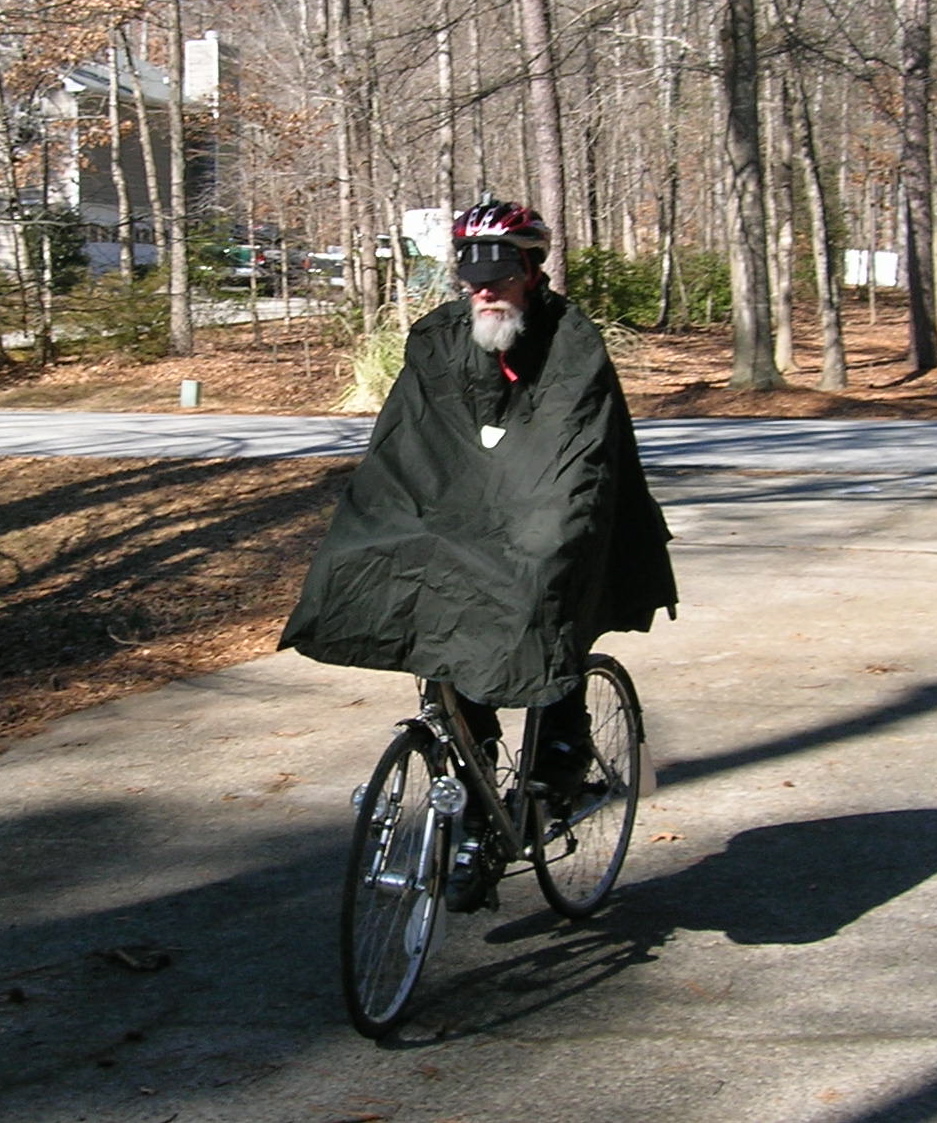
Permit me to introduce you to an old idea.  The Rain Cape.

This is a cycling garment that the Brits (who know a thing or two about rain) have been using for ages.  (I think the idea goes back to horse riders.)

Here’s what it looks like:

This is the cape, neck zip open and hood back.
Please do note, we took these pictures on a sunny day, so that they would show detail well.  We have tested this thing rather thoroughly in the shower, and in the rain.

There are two loops sown into the front.  Hands go through these to keep the cape from blowing up into the rider's face, and to keep it in place over the controls.

There are also a pair of straps sown into the back of the cape.  These tie around the waist, securing the cape from flapping up in the breeze.  That way one's backside stays dry.

A detail view, neck zipped up, hood raised, and helmet on over the whole works.

This is what it looks like in riding position.


There is a generous reflective stripe across the back.

View from the front.  Note fenders.  These help a lot!  Dry above and below.


Rear view, showing reflective stripe and good coverage.

 Does it work?  Oh man does it ever!  I recently spent two hours riding in sleet and pouring rain, with this cape on.  I stayed dry as toast, and quiet comfortable.  (In fairness, I should add, the cape works best when used with a bike that has fenders.)  Yes, there is a high "geek factor."  But what's cool about arriving at work, or the grocery, soaked and shivering? 

Friday, February 4, 2011

Friday Follies ~~ Rain


It’s been a rainy night in Georgia.  Riding in the rain comes to mind.

An observation:  It’s easier to ride in the rain, when you are already riding.  It is very difficult to start riding in the rain.

This particular bout of wet-and-nasty reminds me of two incidents, both taking place on brevets.

Scene 1)  A 600K in North Carolina.  It was a wet and drizzly day in early May.  We started off in a steady light rain.  In the dark.

One group hit the loud pedal and took off.  I ignored them.  This was a 600K, that’s about 375 miles!  I didn’t feel a particular need to rush, but there are always those who do.  I was rolling along with a small group of like-minded folk.  We were approaching a traffic light.  We’d barely gone 10 miles.  The light was a stale green, and the pavement was smooth.  We all reached a quick consensus and slowed, as the light was changing.  We were almost finished with executing a stop, when…

A rider who had been coming up form behind us had decided to accelerate and try to make the light.  Suddenly he was confronted by the group of us…  stopping …in front of him.  He locked his brakes, slid, and fell, and slid more, knocking into me, and dropping me to the wet pavement.

I found an appropriate set of words of thanks, and then continued on.  (I should have taken it as an omen.)

It rained, of and on, throughout the morning, and into the afternoon.  Temps were not warm, but not cold either.  I was getting to the point of really anticipating a lunch stop at a controle.  I was counting the miles.  I would be able to get off the bike, get dry, get fed, and get warmed up.

The store/restaurant came into view.  I dismounted and went inside.  The place was airconditioned to near arctic levels.  I was going hypothermic just standing in the line to order food.  I went back outside, into the rain, to get warmer.  That wasn’t working.  I needed to make some heat, and quick.  I shoved my sandwich into a bag, and mounted the bike.  I rode hard for about five miles (yes in the rain) to warm myself, and then ate a soggy sandwich on the bike.

Comfort is relative.

Scene 2)  A 400K, out of Bonifay, Florida.  It was a grey morning, with a forecast of “light and widely scattered rain” for the afternoon.  My friend Ed and I were riding along in good order.  Occasionally the sky would spit a drop or six on us, but we elected not to stop and pull on rain gear.  We were riding through the desolate back roads of Eglin Air Force Base, when it started to rain in earnest.  It wasn’t severe, just wet.  We stopped and geared up for it.

About a half hour later, we turned north.  It was raining steadily, but not hard, and the temp was a decent mid-sixties.  Shortly after we made that turn we saw it.  We could see the cold front coming at us.  A wall of darker, heavier rain.  It hit us, and in the space of three crank strokes, the temp dropped 15 degrees and the rain increased to torrential.

About an hour later, we had left the Air Base, and were again on trafficked roadways.  Multiple drivers stopped or slowed and practically begged us to let them give us a lift.  (I guess cyclists in the rain are not a common sight in those parts.)  In each case we declined, with thanks, laughed, and kept riding.

Distress is relative too.

Some of the best rides I’ve ever done have been rain rides.  Some of the worst have been wet too.

Friday, November 19, 2010

Friday Follies ~~ BRAPP


Several years ago Mark had a really good idea.  Winter was coming, and of course it was getting harder to get in a weekday ride.  Mark had the thought, “Let’s invite a lot of different folks to each host one Sunday ride during the course of the Winter.”  Each individual ride leader would pick out a route that they liked, and lead a group ride on that route.  In this way many of us could become more familiar with the area, learn more about different ride-able places, and have some fun in the process.  At the same time, we would all become exposed to a lot of different riding styles.

Seemed like a good idea at the time.  And we went forward with it.

It’s important to remember that this was about 1998, and we did not have the large number of riders and routes in the area that we enjoy now.

A couple of the more respected and stronger riders in the community led the first two rides, and they were variations on the longer of the Summer “training ride” routes.  Then one of the ladies from the Newnan crowd took us all on a grand tour of southern Coweta County.  Only about 15 people got lost on that one.  Mark too a turn, and we went on a long ramble, down past Brooks and back.  I had volunteered too, but my turn would not come until well after the New Year.

So what with six things and another, one of the area’s more eccentric riders was due to take us out.  It was a late November ride.  This gentleman (call him Crazy Ron) proposed we go on a big loop that he had devised.  He called it B.R.A.P.P.  That stood for Bike Ride Around Peachtree City’s Perimeter.  (The name was a bit of a play on the acronym for Bike Ride Across Georgia.

I was watching the weather, as I usually do.  The outlook or the weekend was deteriorating as the week progressed.  Also, during the course of the week, Crazy Ron came into the shop several times to describe his proposed route.  He seemed very excited and positive.  (But then, how could one tell?)

On Saturday, a cold front started to roll slowly into the area, and the clouds formed, and it started to rain, just a scattering of slow drizzles.  The outlook for Sunday wasn’t much better.  I had a sort of sinking feeling when Crazy Ron came into the shop with a sheet of paper in his hand.  My premonition was quickly confirmed.

“Hey Steve!”  Crazy Ron said,  “Turns out I can’t go on the ride tomorrow.  Family stuff in Conyers.  I have a cue sheet here.  You can lead the ride for me.  It’s easy.  See ya!”  And with that he left the store.  I looked at his “cue sheet.”  To say the least it was kind of vague.

We had already posted the ride location and time.  It was too late to call it off.

My daughter and I loaded our bikes up, and left into a foggy drizzle.  “Hey, Pops, look at it like this,”  she said,  “In this weather, likely no one will show up.”

Now there was something to hope for.  A vain hope, as it turned out.

There were about eight riders assembled at the school yard, when my daughter and I pulled up.  I got out of the truck, hoping that I might be able to call this thing off.  No one had a bike on the ground yet, and everyone seemed to have that,  “I don’t know.  You tell me,” look on their faces.

I was just drawing a breath to say something like,  “Hey folks, why don’t we just call this off, and wait for a better day?”  I never got the chance.  Just as I completed the inhalation, Matt rolled into the parking lot.  He was already mounted up and riding.  More he was on a road bike.

Now Matt is one of the more positive folks I have ever met.  He is also a demon BMX rider and stunt rider.  No one had ever seen Matt on a road bike before.

“You know what,”  Matt said,  “The hardest thing about a ride on a day like this, is swinging your leg over the top tube.  After that, it’s pretty easy.”  Okay, we were going.

As we were riding out of the parking lot, someone called out,  “Hey!  Where’s Crazy Ron?”

“Um… He isn’t coming,”  I said.  “He left me his cue sheet, and asked if I would take this group out, and…”

“Crazy Ron isn’t coming to his own ride!?

“Ur…  No?”  I said.

“That wouldn’t have anything to do with this weather, now would it?”

I didn’t reply.  We were riding.

The directions through town were pretty straightforward.  And in those days it was quite possible to go out GA-54, to GA-34, and turn off onto Fischer Rd.  That was good enough.  Fischer was (then) a very low traffic kind of back road.  Good thing too.  It was there that the first real goofy thing happened.

I’d dropped to the back of the group to do some cue sheet reading and figuring.  Suddenly I heard a major commotion ahead.  I looked up, and saw that I was about to crash into Matt and my daughter.  The two of them looked like they were already in the process of a slow collision.

Yike!

I hit the brakes, and started to let fly with an angry shout, when I realized that there was a real problem here.  My daughter had just tried to take a drink from her, brand X, back pack hydration system.  As she did, the bite valve had failed.  She’d tried to get it working, only to have it come apart in her hands and commence spewing water all over her.  She’d yelled.

Matt had been nearby, and had reacted quickly.  Matt has skills!  He rode right up next to my daughter, and reached over, with both hands, to help her with the back pack.  In the tangle, Matt was left using both hands to keep the back pack hose crimped, but he was in the way of my daughter’s ability to get her hands back on the bar.  So neither of them could get to bike controls.  The two of them could barely steer.  Stopping was clearly out of the question.

I rode up behind and to the side of Matt, and grabbed his pack with my right hand.  Then I used my left hand (front brake) to bring all three of us to a stop.  The triple dismount was, in a word, clumsy.  No one fell.  No one was hurt.

We improvised a quick fix to the faulty bite valve, and went on.

By the time we three caught up the main group, they had missed two turns. We all spent the next two hours getting unlost.  By that time it was even more foggy, colder, and raining in earnest.  (I think we were in Earnest.  I’ve never seen weather quite like that in Georgia.)

“Hey!  I know where we are!”  Someone shouted.  “We’re in the back side of Tyrone!”

“That’s great!  I replied.  “If you can get me to Main and Castlewood, I can re-acquire the route.”

“Oh goody,”  somebody else said.  “I can hardly contain my enthusiasm.”

As we all rode down Tyrone Rd, in Fayette County, I was thinking about the route.  Specifically, there was a lot more of it ahead, and conditions were not improving.  I asked around.  Would anyone would be disappointed if I cut the ride short?

“Hey!”  Matt said.  “I was kind of hoping someone would suggest that.  You know, if we keep going to 54, and turn right, we can catch Ebinezer Rd, and that takes us directly back to the school.”  There was actual cheering at that announcement.

“Sounds like a plan,”  I said.  I noted that group morale rose sharply.

Five quick and happy miles later we were done.  Everyone congratulated everyone else.  Someone suggested we go find Crazy Ron and hang him.  But that would have been more effort than it was worth.  We all stowed bicycles, started vehicles, and said our good byes.  And just as I put my old truck in gear, the heavens opened and it deluged!

Most of that old gang are gone now, moved or stopped riding.  Matt is running an amazing business out west, and he just recently got married.  I’m not sure if Crazy Ron is still riding, but he doesn’t seem to be leading any rides these days.  Every once in a while, I run into one of the survivors of the BRAPP, and the topic comes up.  We laugh about it.  Those are the rides you remember.


Tuesday, August 17, 2010

Weather Riding: Summer Considerations

There seem to be two things that stop people from riding in the Summer, Heat and Rain.  Let us look at each of these for a bit.

Before we go farther, there is one fundamental that applies to both of these, and to most cycling challenges.  The rule is:  Don’t meet the challenge for the first time on an event.  In other words, seek out the conditions that challenge you.  Practice in them.  Learn to deal with them.  Do this in controlled and limited fashion, and you will be ready if (and when) you meet them in an event.

Heat Stress:  The problem is that the body generates heat.  It must be able to shed this heat, to cool.  There are two controlling variables.  How fast does the body generate excess heat, and how fast can the body shed this heat into the environment.  If we are making excess heat (from exercise) faster than we can dump it into our environment, then our core temperature will start to rise.

Humans generally have a core temperature of 98.6 degrees F.  An athletic human, in good physical condition, can tolerate a rise in core of one to two degrees without too much problem.  If this occurs, we feel hot and overheated, we sweat a lot, and we look for ways to cool down.  But if the core temp rises much above 100 degrees F, then we are heading for trouble.

With a rapid rise in core temp, the body starts kicking in some heavy defense mechanisms.  We really start to sweat.  We often feel nausea, and weakness, trembling, and even chills.  If relief is not found soon, we will be in serious trouble.  Heat exhaustion and heat stroke are no joke.

You will often hear experience cyclists give the advice,  “Ride inside yourself.”  This means, slow down and stay inside of your tolerance range.  Don’t let others push you to exceed your ranges.  But to be able to do this, one must be able to recognize the symptoms, and to take appropriate actions to remedy them.

Heat Tolerance Training:  Back in the Spring, I advocated the first part of this.  That is, ride as close to the heat of the day as you reasonably can.  Become accustomed to the heat slowly, as the season gets warmer.

Johan speaking.  I say wear all the heavy clothing when it gets warm.  Don’t be a weakling.  Hot is goot!
Be tough!
Eat horse!  You want to be fast?  Eat fast animal.  Eat horse.  It will make you strong and fast.

There is a second technique.  Go out and ride in the really hot parts of the day.  But do it in a controlled fashion.  The idea is, you go out for a one or two hour ride, in really high heat, and full sunlight.  Take it easy and slow.  Drink a lot.  Pour water through your helmet.  Don’t get too far from home.  If things are really starting to go wrong, you can bail, and try again another day.  (And by the way, use sunscreen!  Use LOTS of sunscreen.  It will keep you cooler.)

When you are able to tolerate riding for a couple of hours, increase your time.  Do so gradually, in half hour increments.  Build your knowledge of your body’s reactions to heat.  Learn what to do to stay inside that upper cooling limit.  In fairly short order, you will be able to start at around 11:00 A.M. and ride until 4:00 P.M. without undue stress.  At that point, you are ready to take on a full day ride in Summer conditions. 

Really, you don’t want to meet the unrelenting blast of a southern summer day, for the first time, on an event.  And by the way, pray for rain and clouds.

Rain Riding:  I am constantly amazed by the number of cyclists who tell me that they won’t ride in rain.  I can understand this if the temperature is low.  (I think the most miserable a person can be, is outside, in the rain, at 40 degrees F.)  I hear some fears expressed.  Fear is a powerful deterrent.  But it can be overcome with reason and knowledge.  The most common worries I hear are,  “Those skinny tires aren’t safe in rain,”  and,  “I’m afraid of lightening!”  Oddly, I seldom hear folks talk about the trouble with being visible in heavy rain.

Skinny (road bike) tires:  Let’s get real.  It is possible to hydroplane on a road bike, but one must hit deep water, at high speeds to accomplish this.  (six inches or more, and 50 mph or more!)  While it is possible to encouter more than six inches of water on our roads, I don’t see too many of you riding faster than 50 mph.  There are many reasons for the design of modern road bikes, but the most important reason for the shape and size of the thing is…  It works!  Those skinny, high pressure tires cut through rain, and really adhere to the the road.

There are risks of slipping in rain.  Larger tires won’t help.  Look for and avoid the following:  Road paint.  It’s often very slippery.  Don’t ride on lines, etc.  Sand and dirt washes.  If water is washing dirt down off of exposed ground, the slick it causes can be very slippery.  Avoid, or slow way down and ride straight through it.  Hidden obstacles.  Standing water can hide “wheel eater” potholes and other obstacles.  Don’t ride through it, or slow way down first.

A special word about flash floods.  Sometimes we get sudden, very heavy rains.  This can cause streams to rise and fast runoffs to occur.  If you see water flowing across the road, stop and walk.  Be extremely cautious.  A fast current of six to eight inch deep water can sweep a person off their feet and carry them away.  Don’t ride into flooding.

Lightening:  Admittedly, no one wants to be hit by lightening.  However, this is not a serious problem.  Honestly, have you ever heard of anyone being hit by lightening on a bicycle?  There are a couple of common sense things to avoid.  Don’t be the highest object around.  Stay off of ridgelines and other high places.  Don’t take shelter under the only tree around.  Tall, individual trees are lightening rods.  Stay out of large open areas.  (Golfers take note!)  And don’t carry and raise an umbrella.

Visibility (see and be seen):  A very real concern about rain riding is vision.  For obvious reasons we want to be seen.  It is also good to be able to see.  Being seen means being visible.  Wear bright clothing.  Carry reflective gear and wear it at the first hint of rain.  And mount and use a bright flashing rear light.  This last greatly increases your visibility to motorists.  Use it!

In cases of torrential rainfall, it’s probably best to just get off the road.  Let’s face it, you’re already soaked, getting run over won’t help.  Seriously heavy downpours usually last only a few minutes.  It’s best to get off the roadway for a few and let the intensity diminish.

Being able to see, on the other hand, is also pretty important.  Most of us wear sunglasses during the daytime.  I’d recommend a pair that has multiple lenses.  Switch to a clear lens when it’s raining.  Or carry a second pair of glasses with a clear lens.  Another great help is to have a cap with a bill on it.  Wear this under your helmet.  It won’t keep your head any drier, but it stops the downflow and a lot of the splash.  Your glasses stay clearer, and you can see better.  NOTE:  On hot days, I’d keep the cap in a jersey pocket.  You want your head open to airflow for cooling.  Put the cap on, under the helmet, after it starts to rain.

The Argument for rain riding:  This is where both of today’s topics come together.  In the Summer, it gets hot.  Rain cools you off.  It can actually be quite pleasant to be out in the rain on a warm Summer day.  I’m sure most of us did this as kids.  It’s still fun.

Just like hot weather riding, it’s best to start out by riding close to home, on short rides.  But do go out and try it.  The hardest part of a rain ride, is swinging your leg over the bike.