Showing posts with label preparations. Show all posts

Monday, February 15, 2016

AUDAX RIDE AND TUNE-UPS: THE STRUCTURE


In response to several requests, we’re going to take a bit of time here and go over some important specifics about the Audax 200K and the Audax Tune Ups.

Let’s get the money thing out of the way first.  For the Audax Tune Up  rides, you will need to pack snacks, or bring a bit of cash for food along the way.  There is a fee for the Audax 200K.  We’ve tried to keep this down to a minimum.  The fee covers your lunch (at a resaurant) and water at the other stops, and a post ride sandwich snack.  We don’t yet know what the exact amount will be this year, but it is unlikely to be a lot higher than in the past.  In recent years, it’s been $27.00 per rider.  We’ll let you know exact amounts soon.

Ride structure:  We will ride each of the Audax Tune Ups in the same fashion as the Audax 200K.  That is to say, we will stay together as a group.  Some will find the pace somewhat relaxed. Others may need to stretch a bit to hold it.  In general, we try to hold to a 13 to 15 mph rolling average.

Yes!  There will be stops along the way.  Here’s the profile:
            Tune Up I:  35 miles.  One stop, approximately mid-way.

            Tune Ups II and III:  45 miles.  Two stops, one at approximately15 miles 
and one at approximately 30 miles

Tune Ups IV and V:  65 miles.  Two planned stops, at approximately 15 and
40 miles.  One optional stop at approx 55 miles.
All break-stops are kept to a minimum time.  We attend nature’s call, refill bottles, snack, and then roll!  There is an exception to that.  On the 65 mile Tune Ups, the second stop is a “lunch break,” and will be a bit longer.

Audax 200K:  Optional stop at approximately 15 miles.  Planned stop at approx 35 miles.  Planned stop at approximately 50 miles.  Lunch break at approx 65 miles.  Planned stop at approx 82 miles.  Planned stop at approx 105 miles. 

We hope this is helpful in your planning and decision making.


Monday, February 1, 2016

The Audax 200K ~ Starting to Begin to Get Ready

This month, we do the first of the Audax Tune Up Rides.  This one is sort of the “ice breaker.”  Remember, the Audax 200K is a self-supported ride.  One of the aspects of the Tune Ups is preparation for that.  These rides give us the opportunity to ride in “Audax Style.”  They are also a chance to begin the process of riding with the “necessities” of self-supported style.
            There is a bit of a contradiction here.  A Tune Up in February, for a ride that will take place in May.  One could, reasonably ask,  “How much will I learn for a warm weather ride, while it’s still freakin’ Winter!?
            I can hear my father saying,  “It builds character.”  To which I will add, “Yu might be surprised at just what you will learn.”

            Seriously, it is good to start getting the mind into the frame of planning and selecting gear and equipment.  The ride in the group is excellent practice too.

(Just by the way...  You will find the dates for the whole Tune Up series, and the Audax 200K, to the right in the Tour Calendar gadget.)

Monday, January 23, 2012

Audax Ride Preparations: Bike Choices

Each year, as this particular activity looms onto the horizon, I do my level best to supply helpful information.  What is rendered below is hardly to be considered the ultimate in wisdom, but it the sum total of what I have learned, by research, observation, and personal experience.

It is my fond hope that riders new to distance/endurance/touring type riding will find this helpful.  I rather think there may just be a tidbit of some worth for the more experienced rider too.

This is about what works best for this particular kind of ride. 

What Does Not work:
I’ve found this to be a necessary warning.  While I don’t try to discourage folks from doing what they think works for them, long (and sometimes bitter) experience has shown that the following do not do well on this ride, or on the preparation “Audax Tune Ups.

  • Mountain bikes.  (More, it does not matter if a mountain bike has had the tires replaced with thinner slicks.  It’s still a mountain bike.  It’s still not efficient.  It’s still a bad idea.)
  • Comfort bikes
  • Cruiser
  • Hybrids
  • Flat bar road bikes (sometimes called “Fitness Bikes”)
In short, just about any kind of bike with a flat or straight handlebar.  I’ve seen it tried a lot of times.  It doesn’t work.  Period.  Use the right tool for the job.  Or more bluntly,  “Don’t bring a knife to a gunfight.”

What Does work:
Almost any kind of drop handlebar road bike will do, IF you are comfortable on it for longer periods of time.  That means it pretty much has to fit you well, and the saddle has to work well for you.  If you are not sure about your fit, have it done.  Get a good sound professional bike fit done.  If you are not sure about your saddle, come out and do the Audax Tune Ups.  After riding 45 miles (or 65 miles) you will know whether you have saddle “issues” or not.  (If so, come see me at Bicycles Unlimited, and we’ll discuss options.)

Why? 
The purpose of this little discussion is to recommend the best choice for this kind of endurance/light touring riding.  Read this if:

You have a bike and don’t plan to replace it, or to get another bike:

You don’t have a bike:

You are considering the purchase of a(nother) bike:

Here’s my recommendation:
You can do this kind of ride on almost any road bike.  It’s not really so long as to require a dedicated touring type bike.  I would recommend bikes with more relaxed geometry, as opposed to all out racing machines. 

We have had folks do this on time trail bikes, and they’ve done okay, but unless you are deep into training for IronMan type events, I’d suggest avoiding this choice.

A “light tourist” is not a bad choice.

It most certainly can be done on a cyclocross bike, but I’d go for slightly narrower (and smoother) tires.

Tourists are a bit heavy for this particular kind of riding, but will work.  They tend to have more relaxed geometry, and their carry-capacity is hard to beat.

Monday, January 16, 2012

Preparing for The Audax Ride:


Going long more a state of mind than it is a physical act.  That said, getting the bod and bike in condition are good and worthy actions.

The body:  To begin with, just get into the saddle.  Do it now.  Do it regularly.  Do it often.  Start with five to seven hours per week.  That’s not hard to accomplish.  Do a one hour ride on every weekday, and one two hour jaunt on the weekends.  Keep the effort level low, and enjoy  the thing.  Alternately, three each hour-and-a-half ride, evenly spread through the week would work well.  The key is to be on the bike, and to do it consistently.

If you can, make two of these rides into fairly serious workouts, and the others very low-key.  But time on the bike is more critical than high effort.

Weather and darkness can make some of this a little difficult.  Spin Class can help.  We do a great one at Bicycles Unlimited.  I’d avoid a gym type class.  Most of them are “suffer parties” which don’t target specific areas a cyclist needs.

Note:  It’s not possible to be consistent part of the time.  The goal is to ride regularly, and do it spread throughout the week.  A five to seven hour thrash, once a week, will do more damage than good.  Put another way, it’s not possible to make up for three off days, by riding three times as long on the fourth.

The Bike:  For now, get it clean.  Lubricate the driveline.  Inflate the tires.  Get any minor problems fixed.  Go Ride.  You’ll want to get a good thorough tune up done around the end of the first week of February.

The first of the Audax Tune Up Rides is on February 26.  The trick it to get any real deficiencies identified and corrected by then.

We’ll soon have more on this subject, including the hows and more importantly the whys.  Until then, go out and ride!  Engage this week, and enjoy it!


Monday, December 19, 2011

The Temple:

There are many ways to approach the act of riding a bicycle.  Readers of this blog do not often see me advocating the “just get on it and ride” approach, although that is quite valid.  I like the idea of bikes that are built and equipped such that no special preparations need be made to ride them.  There is a whole mindset of capital C cycling, that one must be on the right bike, wearing the right gear, etc.  Unfortunately, this perception tends to be intimidating and off-putting to many who could and would derive a great deal from cycling.

That said, the capital C cyclist certainly does have much to give and gain.  I like the whole aspect of having the right bike for the intended purpose, and equipping it, and myself correctly and well for the task at hand.  When I am commuting, especially in the Winter, there are a whole series of preparations to be made prior to the ride.  Weather must be observed, clothing selected, other choices have to be considered.  And, at the end of the day there is the reverse series of tasks, putting all the stuff away and readying for the next time.  To an extent, every ride contains a bit of this preparation.

Observation of the Proper Forms:  Some rides are more important, and more than casual.  These require more preparation and mindful attention.  I think of these special occasions as being akin to preparing for worship.  There is a liturgical aspect to them.  One is about to enter the Temple.  Reverence, Respect, and Good Preparation are required and needful.  It is ritual that we speak of here, or possibly meditation.  The correct and orderly, careful, and detailed preparation, is required to focus the mind and bring seriousness of purpose, before embarking on the mission…  or before entering the Temple.

I am, of course using metaphor here, but a very close one.  There are certain rides that amount to a form of worshipfulness.  The annual Ride of Silence comes to mind, but there are others.  Remember, not all worship is grim.  In fact, the old word “solemn” actually meant a purposeful celebration!  And there are many religious observances that are joyous and glorious celebrations.

How many of us prepare for our riding with that kind of za-zen deliberation, meditatively, calm, and yet celebratory?  I wonder that.  At the same time, I hope there are a lot among us who do, “prepare to enter the Temple” before riding.

Come on out and celebrate with us tonight!  It’s time for the Annual Christmas Lights Road Ride!  (Details can be found at the bottom of last Thursday's Post.)

Wednesday, April 6, 2011

65 Miles Audax Style


Let’s sum up the whole Audax concept in a few short phrases.
We will finish the ride.
We will stay together as a group in mutual support.
We will go in any weather.

This coming Sunday, we turn the wick up a bit.  This is the first of two 65 mile Audax Tune Up Rides.  We’ll be starting a bit earlier, and going a bit longer.

As of this writing, the forecast for Sunday looks favorable.  But remember that any weather phrase.  Do watch the forecasts, and be prepared to dress for the weather.

A note on dressing and other equipment:  It is, after all, still early Spring.  It could be kind of cool when we start, and become quite warm before we are finished.  For that matter, it’s not unusual for us to experience a high early in the day, and have temps drop sharply as the day goes on.  Either way, it’s likely that we could have to carry some extra clothing.  Give some thought to just how you will do this.

Before going any further, in the interest of disclosure, I tend to favor the concept of using the bike as the beast of burden.  I think the weight should be on the bike and not on the rider.  Mine isn’t the only opinion on this subject.

Back Packs:  Of course a back pack will work, but remember, you have to carry the weight of the pack, and the clothing.  With packs you use energy to support your load, as well as to move it down the road and over the hills.  This is likely to be a 5+ hour ride.  Do you really want to support that stuff on your back for that long?  If the answer is yes, then go for it.

Other Options: 
Luggage rack and some kind of bag or pannier is another method.  The “infrastructure cost” is possibly a bit higher than with a back pack.  (Infrastructure cost is the effort necessary to move the stuff that supports the stuff you are carrying.  In other words, it amounts to the weight of the carrying system.)  On the other hand, you don’t have to support it.)

PIX
Pannier mounted on rear rack.

A packed touring Pannier.  (Shown with water bottle for scale)

Touring Pannier (side view)

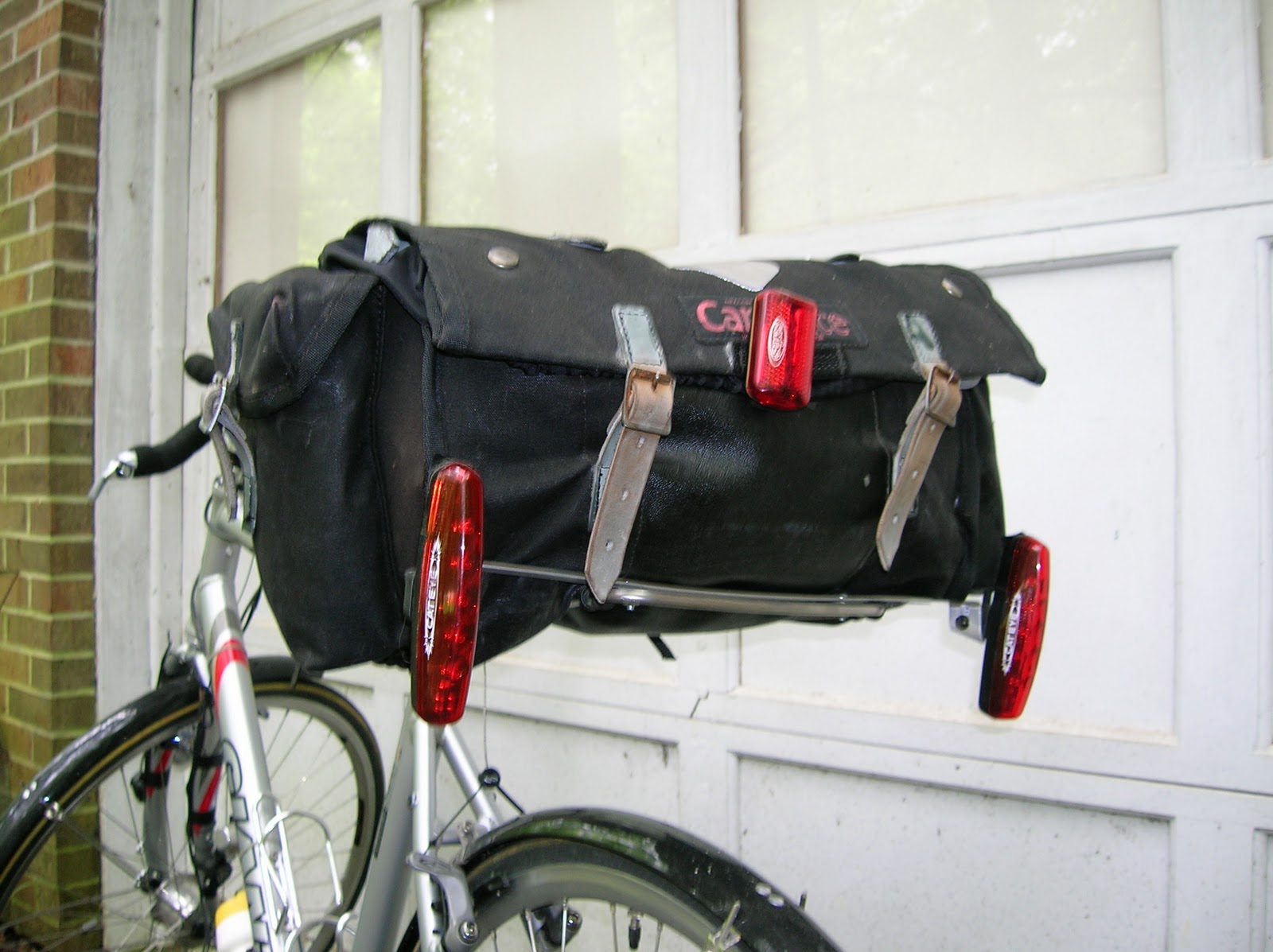
Large Saddle Bag:  Here the “infrastructure cost” is lower, often lower than for a back pack.  These are not necessarily as capacious as the rack & trunck or rack and pannier setups, but they are more efficient.  On the downside, these tend to cost a bit more.  On the positive side again, they can be more readily removed and installed than the rack and panniers.

A capacious English touring saddle bag, by Carradice.  This one is suiteable for a one or two day tour.

Another view of the large Carradice bag.


Medium Saddle Bag:

A somewhat smaller Carradice bag.  This one would be more than ample for a one day Audax.


A More Minimalist Saddle Bag:

Made by Topeak, this bag is quite roomy, not bulky, and very low "infrastructure cost."


And of course…
If you really and truly need to carry a lot of stuff, there’s this…

Trailer by B.O.B.  One could go for weeks with this rig, but it's definitely overkill for  a one day tour.
Hey!  That last one was for grins.  Honest.


What you should carry this trip:
Of course this is somewhat dependent on the weather.  But a likely list is
  • Arm warmers
  • Polypro or light wool base layer
  • Windshell (a rain jacket can do double duty here)
  • Rain jacket
  • Wind vest
  • Leg warmers
  • A cap with a bill  (see tomorrow’s post for more on this)
  • Sunscreen
  • Some food (it’s going to be about a 2400 to 3000 calorie day.  We will stop several times, but carry what works for you.)
  • At least two water bottles (or the equivalent)
  • Two spare tubes in your size.
  • Any spares that are unique to your bike.
  • Any meds that you might need
  • Phone (Optional.  Please do not get into conversations while out on the ride.)
  • Camera (totally optional)
  • Some money for water and snacks
  • Sunglasses
  • Riding gloves
Have fun working out your own list.  And try packing it and carrying it for this coming week's ride.  It's good practice.

Tuesday, March 15, 2011

Mountain Biking 101: Preparations


The two most reliable ways to annoy your fellow riders are 1) show up late for a ride and expect folks to wait on you while you fumble around.   2)  Be that rider who is always shouting  “Wait!” because you dropped something, or something fell off of your bike.

A third widely recognized method of aggravating riding companions (and yourself) is to suffer from easily avoidable “mechanicals.”

How are we to avoid these pitfalls?  Actually, it’s not hard.  The key is preparation and post ride action.

Think of it like this, your ride starts the day before.  That’s when you begin your preparations.  Go over your bike.  Make sure that everything is on it, and it all works.  Check to be sure that everything is working, and it’s all secured.  Then prepare and assemble the rest of your gear, in one place, ready to go.  Here’s the day before checklists.

Bike:
  • Clean enough
  • Tires holding air
  • Chain lubed
  • Driveline working (shifting up and down correctly in all gears, front and rear)
  • Saddle secure and at correct height
  • Handle bars not loose
  • Steering free and correct (not binding and no “clunks”)
  • Brakes working, front and rear
  • Accessories all firmly attached and working (Under seat pack, Lights, bells, bottle cages, etc.  If it’s connected to your bike, check it!)


Support Gear:
  • Pump ready (near bike)
  • Helmet hung with bike
  • Water bottles (or back pack reservoir) clean and filled with fresh water.  (Okay, go ahead and put this stuff with the bike now!)
  • Batteries charged (if you are going on a night ride)
  • Tools (inventoried and in under seat pack)
  • Spares (tubes, patches, and anything else you use) inventoried and stowed correctly
  • FOOD (enough said?)
  • Ride clothing, shorts, jersey, gloves, jacket, socks, glasses, etc. (go ahead and lay it all out now.)
  • After ride clothing  (You really don’t want to keep wearing your riding clothes for longer than necessary, do you?)


One more thing.  Timing.  Arrive a bit early.  Give yourself some time to unload your bike, pump tires, check and stow your gear properly, and do it all well before the agreed upon ride time.

After the Ride:  We mentioned Post Ride Action.  This is it.  Consider this to be part of the ride.  Do these things as soon as you get home, and you’re already on the way to being ready for the next ride.
  • Clean the bike.
  • Inspect tires for foreign objects, thorns etc, cuts, or other damage.
  • Lube the chain
  • Check bearings, wheels, brakes, shifting.  If something needs attention, or repair, go ahead and make the arrangements now.
  • Empty and rinse out bottles or back pack reservoir, and hang to dry now.
  • Get that clothing into the wash
  • Inventory and replenish any tools, spares, and supplies used
  • Clean it, Inspect it, fix it, replace it, put it away, and do it now.

 One last note:  The last of our Winter Series of Novice Mountain Bike Rides is this coming Sunday, 2:00 PM, at the Peachtree City Baseball Soccer Complex.  These rides will become a regular weeknight event in April.

Today’s Term(s):
yard sale n. (from skiing) a horrendous crash that leaves all your various "wares" -- water bottles, pump, tool bag, etc. -- scattered as if on display for sale.
Mechanical  any problem with the bike, (flats, bad shifting, brake failures, something coming loose) that stops your ride.
Taco  damage to a wheel (usually from poor maintenance coupled with overly exuberant riding) that results in the wheel resembling the famed Mexican food shell.
Three-hour tour n. a ride that looks like a piece of cake at the outset but turns out to be a death march. Derived from the theme song to "Gilligan's Island."


This series, running every Tuesday, is intended to help those who are new to mountain bike riding.  By no means is it an exhaustive treatment, but it is our fond hope that it will help you, the beginner, to begin to enjoy riding your bike off road.

Future Topics:
Bike Types
What to carry (& why & how)
Standing and staying loose (expect the unexpected)
Trail Care & Maintenance
Hydration
Track Stand
Bunny Hop
Wheelie
“Cleaning” the mud
Your next mountain bike  or  Mountain Biking 201

Wednesday, January 26, 2011

A Different Project


Folks, I’ll bring you the next episode in the current series on bike maintenance, but it will be next week.  I’m taking a short “time out” on that project to do some testing on another one.

Of course this new project involves riding, and I’ll let you know what it is, and the results in the very near future.  Just this one hint, I needed the right weather conditions for this test, and this morning’s rain and cold are just about perfect for it.  I have to strike while the iron is hot.

More in the very near future.

Monday, November 8, 2010

Weather Riding: Suddenly Winter


What happened?  I went away for a week.  I left you all with a perfectly good late Autumn.  I figured you could handle that.  But I came back to…  Suddenly it’s Winter!

Okay, let’s poll the jury.  What do we do about this?

Johann speaking:  This is not cold.  Go ride the bike!  Cold is when the tires freeze and break.  Arm warmers and vest are all a real rider needs.  If you get cold, ride harder to make warm.

Bill here:  I think, since your planet has climates, that I will simply go south, below the equator, to where you are keeping Summer now.  Your birds are smart enough to do this.  So why don’t the so called “higher species”?

Road Dragon:  Most of us are mere mortals.  We are not blessed with the toughness of our Belgian friend.  We don’t own a personal flying saucer.  So we have to cope with the climate and conditions we are faced with.

And just what is facing us?  For those of us fortunate to live in north Georgia, we can expect the following for the rest of the Fall, and the Winter to come.  There is a la nina event.  This can make long range prediction hard, but the smart money is betting on the following.  We will have a warmer than usual Winter, but we can expect that to be on average.  We can look for much bigger swings or “excursions” from the norms, and averages will be higher.

That means we can expect to see some really chilly days, and some really warm ones.  We can also expect to see a wider daily temperature swing.  And (good news for cyclists) it will be, generally a good bit drier.

What does that mean to me?  That kind of depends on the type and amount of riding you are doing.

For short rides, between one and two hours, you can dress for what you see.

For longer rides, two to four hours and more, you are going to have to carry more stuff.  If you start out in the early part of the day, it’s likely to be pretty chilly, but it will warm up and you will be overdressed.  Similarly, if you are starting out in mid-day, it will be warmer and warming, but along toward late afternoon and evening, the temps are going to drop.  This just might be a year to rig a rack and some kind of carry bag to your training rig.

We can also expect different weeks of weather.  There are going to be some surprisingly chilly weeks ahead of us, but they are going to be interspersed with some fairly warm ones.

All this amounts to some challenges to consistent training.  The general strategy is; be flexible and adaptable.  Have your cold weather gear ready, but be prepared to enjoy the nice days too.  Don’t put the rain gear away.  (Dryer does not mean no rain.)  And be ready to bailout to the indoor trainer. 

A word on indoor training:  This just might be a very good year to get into a Spin Class.  Remember, consistency is golden.  Of course there are going to be days when you go to spin class, but it was brilliant, sunny, and warm.  On the other hand, there are going to be plenty of days when you are going to be glad to ride inside.

I recently had a conversation with a relatively new arrival to our area.  She said something like,  “This is the south!  I thought it wasn’t supposed to be cold here.”  I reminded her, as I do you now, of the lyrics of the song Dixie

In Dixie land whar I was born in,
Early on one frosty mornin’

The emphasis is mine, but the sentiment bears notice.  It gets cold.  We have a choice.  We deal with it, or we give up.  I think most of you are the “deal with it” type.

We’ll talk more on specifics in the very near future.  It’s good to be home!

Wednesday, September 8, 2010

Touring: What have I got myself into?

The PLAN is to ride to Pine Mountain this weekend for the Cox Atlanta Bike MS event.  I’ll describe elsewhere, how I intend to do this.  But suffice it to say, I am now wondering if I can pull this off.  That’s not unusual.  Every tour event I’ve ever done has had this feeling about it.  It comes on just before the event.  Doubts.  Can I do this?  What have I forgotten?  Did I train enough?  Is the rig too heavy?  Should I leave more out?  Should I carry more spares?  Will my legs handle the loads?

I see this in lots of other folks too.  I think it’s sort of natural.  We look forward to an event.  We plan for it.  We work to make it happen.  And then, close to start time, we begin to have doubts and worries.

Some of this is performance anxiety.  The “Am I going to screw up and let myself and everybody else down?” kind of worries.  Some of it is the “Night before Christmas” kind of anxiety.  Some of it is, for athletes, a product of the necessary shape of training.

Wise athletes, and all coaches know that training must end.  It must end a good bit before the event.  If not, the athlete will not be well rested.  But that leaves the athlete with a problem.  He or she has been dedicated to following a rigorous training schedule.  Athletes are accustomed to having little time, and working under demanding loads.  Suddenly, training tapers off, and time, free time, is available.

Two temptations occur.  The first is to go out and do something!  The second is to worry.  Both are unhelpful.

In my case now, as in the case of a lot of adult amateurs, there is really little to worry about.  This is a fun event.  There is absolutely no pressure to perform.  It’s just that I’m in the habit of preparing for demanding events, with set goals.  Worse, now that training is over, and resting is the rule, I have time to worry.

And that, in a nutshell, is what stops a lot of us from truly enjoying the recreations we pursue.  We’re in the habit of setting and meeting goals and expectations.

The cure?  Simple.  Sit back.  Take a deep breath.  Let the worry go.  And now go out and have a grand old time with it.  In the long run, it doesn’t matter whether it’s glory or goof, and both make good stories for Winter “bench racing.”

I'll let you know how it goes.

Friday, July 23, 2010

Friday Follies ~~ Cleaning the Shop


The word “shop” can be interpreted a lot of different ways.  (English is such an incredible language!)  I maintain and operate a considerable repair, maintenance, and fabrication shop at my home.

Over time, projects tend to happen.  Sometimes a very necessary overhaul will occur at the same time that a prolonged “build” is taking place, and then several repairs interrupt both of these.  New projects are often conceived and start execution here.  Tools are selected for remote projects or events, and parts and supplies tend to pile up, in between jobs.  The “fleet” is stored here, mostly hanging, but some at ground level.

In short, it can get a bit messy.

From time to time, it becomes necessary to clean things up, to restore order, to add organization.  At times like this, “cleaning the shop” becomes a shop project in itself.

Questions arise, such as,  “Just where will I store that?”  Or, “Should I finally throw these old center-pull brakes out?”  Or,  “What on Earth am I going to do with all those old 27” wheels?”  And,  “Where in the wide world am I ever going to find a place to store all these tires?

Frames lurk under stacks of boxes.  Parts cover the benches and tables.  Tools are beginning to pile up on the main bench.

When it gets hard to get to the big vise, or difficult to work at the truing stand, it is time to clean up!

One of the problems with cleaning the shop, aside from the time it takes, is that there is a tendency for the clean up project to spawn other projects.  Sometimes these are so compelling that they divert attention from the original purpose.

I’ve been known to embark on a general cleanup and organization, stop part way through, because I found a part or two that would be just perfect as part of a new concept.  Before I know it, there are two bicycles partially disassembled, and three on the way to becoming.  The mess is worse, but there will be three “new” bikes at the end.

I’m sort of in the middle of one of those times now.  That’s odd.  Usually large shop projects take place in the Winter, when time doesn’t press so heavily, and it’s a bit easier to decide not to ride.

But yes, I am in the midst of cleaning the shop.  So don’t bother to come near it.  Tiptoe past.  Please don’t give me any excuse to stop the work.  I find enough of those without any outside distractions.

NOTE:  See this coming Monday’s post for full details on the upcoming MidSummer’s Eve Night Ride.

Thursday, May 13, 2010

Thursday Thoughts ~~ Why Not?

(See the post from 5/4/10 for Audax 200K details)

The weather forecast for this coming Sunday is for 68 degrees F at ride time, rising to a high of 83 degrees F.  There is a chance of widely scattered showers.

What is a prospective rider to do?

Answer:  Bring a rain jacket, a helmet cover, sunscreen, and ride!  The rain gear is light and doesn't take up much room.  It's good practice to do this on any long ride.

There is a chance of some rain.  In the afternoon.  It’s by no means a certainty.  Although it should be said, if one rides long enough, the likelihood of encountering rain increases pretty sharply.  The thing is, riding in the rain is no big deal.  It happens.  On a warm day it can be kind of pleasant.

A few years ago, on this ride, we hit rain during the last 20 miles of the ride.  I was a bit apprehensive.  I wasn’t worried about the rain so much.  I’ve logged many a mile in it.  Rather, I was concerned about how my group of riders was taking it.  And how was that?  Well, they were laughing and joking with each other.  At the end of the ride a couple of them actually came up to me and thanked me for the wet finish!  They had enjoyed the refreshing feel of being cooled down, and they’d had fun.

Excellent!

Wednesday, January 27, 2010

Audax Routes ~~ What to Expect

There are three routes used in this process, two different “Tune Up” rides, and the actual 125 mile Audax Ride route.  The Tune Up routes are, deliberately, a bit tougher terrain than found on the actual Audax Ride.  This is to prepare riders for the full on ride.  It’s nice to know that the actual ride is longer, but generally, not as difficult.

45 Mile Routes:  The same route is used for both of the shorter Tune Up Rides.  (Strong suggestion:  If you are new to this, plan on doing all three of the Tune Up Rides.  This will help you prepare, mentally and physically.) 

The terrain is hilly, but not severe.  This early in the year, expect to face windy riding.  Plan to carry extra clothing on the earlier rides.  Weather can be changeable.

There will be a stop at about 15 miles.  Then there is the option of another stop at around 30 miles.  The objective is to finish these rides in close to three and a half hours.

65 Mile Route:  This one is hilly.  Specifically, there is one long “grinder” between about mile 21 and 24.  Then there is a series of really big “rollers.”  It’s a delightful tour into the Chattahoochee Hill Country and back.  There is, at this date, a bit of uncertainty about the actual route.  This will depend on when (and if) a bridge is repaired.  Don’t worry about this.  There is a decent alternate available, and it will not alter the basic character of this ride.

There will be a stop at about 15 miles.  The second stop is close to the 40 mile mark.  There is an optional stop at about 55 miles.   The objective is to complete this ride near six hours.


Tuesday, January 26, 2010

Audax Ride Preparations: Riding in Groups

Riding in a group of cyclists can be a real challenge.  It’s hard to know what the “rules” are.  They tend to vary from group to group and ride to ride.  This can be especially challenging for a newer rider.  So let’s discuss some of the aspects of doing this in and Audax style environment.

Audax Riding:  This is a bit different from most group rides.  Many rides tend to become “races without rules.”  Audax riding is not about finishing first, but rather about going the distance and finishing together.

On Audax style rides, it is more important to work together than to try for maximum speed.  If you are unused to riding in a group, don’t feel intimidated.  There is no need to ride extremely close to other riders.  Communication is essential.  Let other riders know what you are going to do.  Call out and point out obstacles.  Announce when you are slowing, stopping, or doing something sudden.  Expect to come to a full stop at stop signs.  Then to proceed in pairs, after each pair has made a full stop.  Don’t worry, the ride will slow, and then re-group after each stop sign.  Stay inside your comfort zone around others.  And be prepared to let them know, politely and early, if you feel crowded.  It’s okay.

Pacing is important.  This is not truly a “no drop” ride.  There is a pace.  There is a schedule.  There is some flexibility, but it is not unlimited.  The spirit of the thing is “One for all, and all for one!”  That said, each individual has a responsibility to aid the group in maintaining good progress.  Pace line riding is not an essential skill for this kind of ride.  More, the Tune Ups are a great place and time to work on those skills.

What we are training for is a rolling average of about 15 miles per hour.  That’s a lot faster than a lot of folks might think.  Rolling average is what the average speed function on most bicycle computers gives us.

I don’t honestly expect to hold that average on the Tune Ups.  It’s a goal.

If a rider is lagging behind the group, I will move that rider to the front of the group, just behnd the lead.  This is not punishment.  The pace of the group is controlled by the best pace that the slowest rider can manage.  More, a slower rider will find that, when drafting behind the group lead, they will have a strong advantage, and overall pace will increase.

There are a couple of places in each of these routes where we relax the “group stays together” rule a bit.  Then we re-group and continue with a common purpose.

Spirit of Compromise:  Every rider has some “specialty,” some area in which they are stronger than others.  Some are climbers, some are great descenders, some can sprint, and some can just diesel along in the flatter terrain.  What happens on these rides is that everyone must limit the thing they are best at, and work a bit harder on their weaker areas.  The objective is to reach the end without over-taxing any member of the group.  It can be a lot of work, but it’s incredibly rewarding.

A word on the routes:  The Tune-Ups are deliberately run over terrain that is more demanding than the actual Audax Ride.  How can that be?  There’s a mountain in the middle of the Audax Ride!  The answer is simple.  There is more climbing, or elevation gain, per mile in the Tune Up routes, than there is on the Audax Ride.


How the Tune-Ups are ridden:  We start out at a very easy pace, to allow warm up on the route.  After 15 to 20 minutes, expect the pace to pick up.  In order to meet the intended average, it is necessary to ride above that speed for most of the ride.  We need to capitalize on every bit of flatter terrain, and every bit of descending.  It’s about efficiency, not about racing.  These are training rides.  We are working on fitness and skills.  But they are not intended to be grim.  Camaraderie is a big part of this whole experience.  It’s fun to ride socially!

Tomorrow:  What to expect from the Tune Up routes

Monday, January 25, 2010

Audax Ride and the Tune Ups

First off, for some of you, the idea of riding 45 miles in a group may be a bit intimidating.  Please don’t be put off by it.    Please read the next paragraphs carefully.

Basic Fitness preparation for the 45 Mile Tune Ups:
Ride your bike…  Regularly!  Each and every week.
Build your time on the bike gradually.
By the beginning of March be averaging 7 to 10 hours of riding every week.
Do at least one three hour ride every week, starting in mid-February.
Take it very easy during the week of March 14 – 20.

Bike & Equipment preparations:
Road bikes please.  I am not a “bike snob.”  I suppose it’s possible to do this kind of ride on a hybrid, fitness, or mountain bike.  However, every time I’ve seen someone try this, sooner or later, they have gotten into trouble.  It’s like showing up with a knife for a gunfight.  It just never ends well.
You will want to have gearing that allows you to climb.  All of these rides are hilly.
Have your bike tuned and inspected before the middle of February.

Plan to carry the following:
Two Water bottles.
Two spare tubes
Your favorite ride food
A bit of money to buy water and munchies at the stops
Any unique spares your particular bike may need
Sunscreen
A wind jacket (possibly a rain shell)
A strong tail light and reflectors are a good idea.

Strong suggestion:  Carry the “stuff” you will carry on the bike.  The bike is your beast of burden.  You have to provide the power to move everything you carry.  You should not have to use energy to support it on your back.  Start practicing, and testing, loading plans and methods now.

Tomorrow:  Riding in Groups